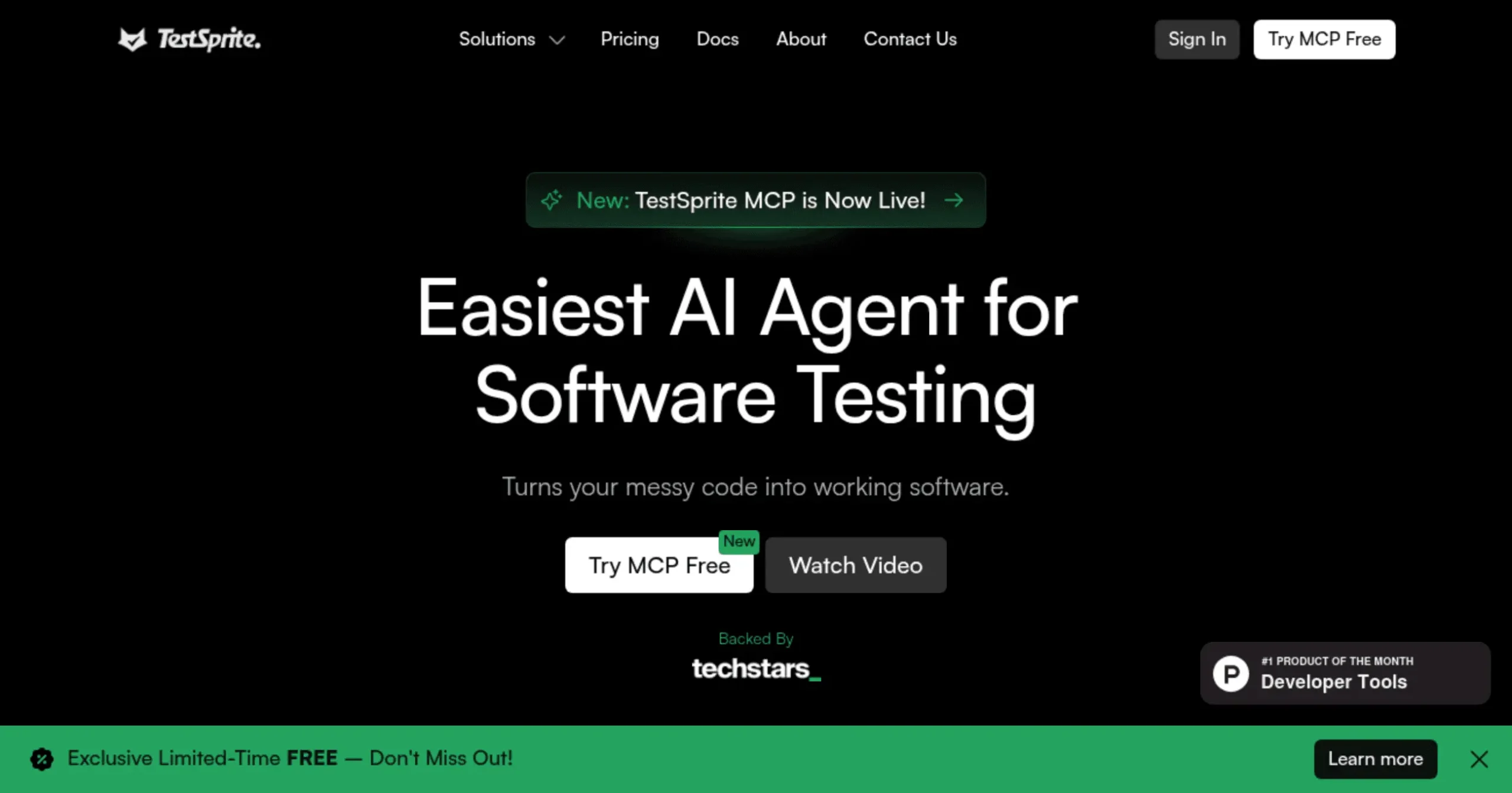
TestSprite Introduction
Picture this: You've just finished building a new feature that took weeks of hard work. But before you can celebrate, you remember the hours of testing ahead—checking every button, every API call, every possible user action.
What if you could skip all that manual work and still ship bug-free code? TestSprite promises to handle your entire testing process from start to finish.
This AI-powered tool writes test cases, runs them, fixes issues, and gives you detailed reports—all while you focus on building your next feature. For busy entrepreneurs and small development teams, it could mean the difference between shipping in days instead of weeks.
We spent time exploring TestSprite to see if it lives up to these big promises.
Does it really save you from tedious testing work? Can it catch bugs as well as a human tester? And most importantly, is it worth adding to your toolkit? Let's find out what this autonomous testing agent can actually do for your business.
TestSprite Key Features
End-to-End Autonomous Testing: Takes care of your entire testing process from start to finish, so you can focus on building features instead of checking for bugs. This means your team saves hours every week that would normally be spent on manual testing.
Model Context Protocol (MCP) Server: Works directly inside your coding tools to automatically check and fix AI-generated code. This ensures your AI assistant’s code actually does what you want it to do without extra work from you.
Comprehensive Backend API Testing: Tests all aspects of your APIs including security, speed, and how they handle multiple users at once. You get detailed reports that show exactly what needs fixing, making troubleshooting much faster.
Automated Frontend UI Testing: Tests how users interact with your website or app automatically, checking buttons, forms, and user flows. This helps you catch problems before your customers do, protecting your reputation.
Natural Language Documentation Integration: Reads your project documentation written in plain English and creates tests based on what it understands. This means you don’t need to write complex test scripts – just describe what you want in simple terms.
CI/CD Pipeline Integration: Plugs right into your existing development workflow without disrupting how your team works. Every time you update your code, tests run automatically, catching issues before they reach your customers.
Our Take of TestSprite
TestSprite brings something different to the table for entrepreneurs who build software products. If you’re running a small development team or bootstrapping your tech startup, you know testing eats up massive chunks of time that could go toward building features your customers actually want.
The platform handles the entire testing process from start to finish. It writes test cases, runs them, finds bugs, and creates reports without you lifting a finger. For business owners wearing multiple hats, this level of automation could mean the difference between shipping updates weekly versus monthly.
What makes TestSprite practical for smaller operations is how it plugs into your existing tools. Whether you use GitHub, GitLab, or other popular platforms, it fits right in without forcing you to change your whole workflow. The Model Context Protocol (MCP) Server even checks AI-generated code automatically, which matters more now that many developers use AI assistants to speed up coding.
The real value shows up in time savings. Instead of spending hours clicking through your app to test every feature, you can focus on talking to customers, planning features, or improving your product. The platform tests both your website’s user interface and backend APIs, covering security, performance, and functionality in one sweep.
Some rough edges exist. The tool sometimes flags problems that aren’t really problems, which means you’ll need to double-check its findings. Advanced features take time to learn, and you need an internet connection since it runs in the cloud. These limitations might frustrate teams that need precise control over their testing process.
For entrepreneurs generating $500K+ annually who want to speed up software releases without hiring a dedicated QA team, TestSprite offers solid ROI potential. The time you save on manual testing translates directly into faster feature delivery and happier customers. Just factor in the learning curve and occasional false alarms when deciding if it fits your operation.
TestSprite's Pricing
The Free plan costs nothing and includes 150 credits per month, access to foundational models, basic testing tools, and community support.
The Starter plan is available with a limited-time offer: the first month is free, then $19 per month from the second month onward (regularly $69). It provides 400 credits per month, access to advanced models, optimized execution, and priority support.
The Standard plan, normally $229, is currently available at a discounted rate of $69 per month and includes 1600 credits, advanced models with custom configurations, optimized performance, and priority support.
Finally, the Enterprise plan offers a fully customizable package with tailored credits, private AI models, API access, and dedicated support, with pricing available upon request.
Final Thoughts about TestSprite
Testing takes time away from building your business. Every hour spent clicking through screens and checking functions is an hour not spent talking to customers or planning your next big feature. TestSprite changes that equation by handling the tedious parts of quality assurance while you focus on what matters most.
Think about your current testing process. How many times have you pushed back a launch because you found bugs at the last minute? How often do small issues slip through because manual testing takes too long? These delays cost money and frustrate customers who expect smooth, reliable software.
TestSprite offers a practical solution for entrepreneurs who want professional-quality testing without the overhead. The platform saves you real hours every week—time you can reinvest in growing your business. While it has some quirks to work around, the overall value proposition is clear: faster releases, fewer bugs, and more time for strategic work.
Ready to see how much time you could save? Click here to try TestSprite and experience automated testing that actually works for small teams. Your future self will thank you for making the switch.
TestSprite FAQs